

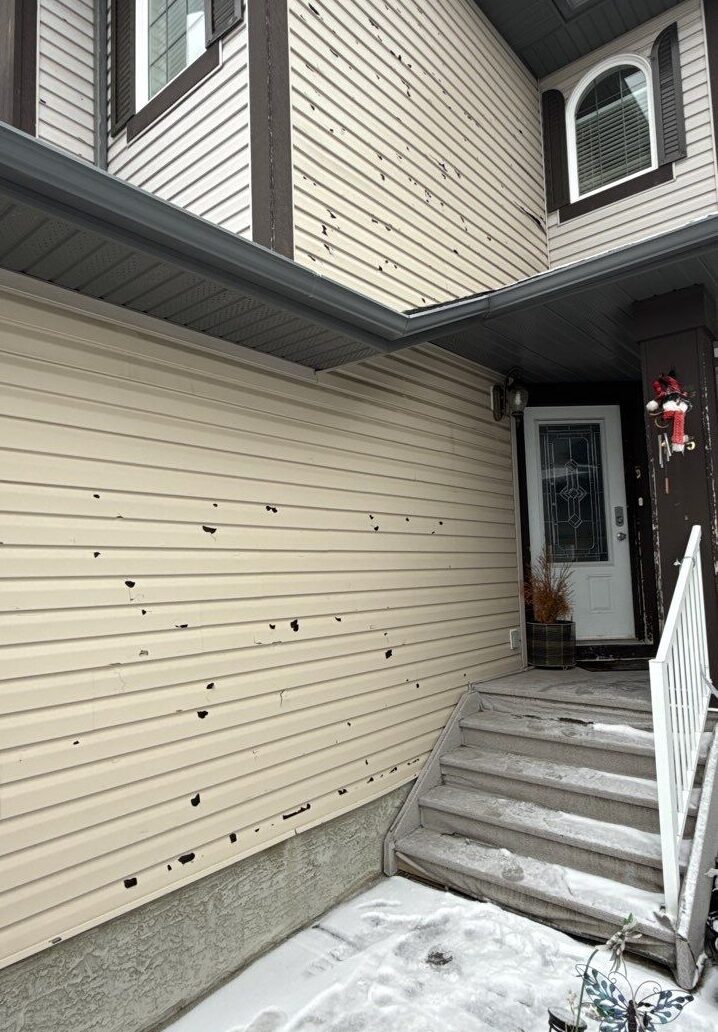
Calgary sees more hail than almost anywhere else in Canada. The city sits in what meteorologists call “Hail Alley” – a corridor stretching from the foothills through southern Alberta where warm, moist air collides with cold fronts rolling off the Rockies. For homeowners, that geography has real consequences. A single storm can take years off a roof that was otherwise in good shape.
What makes hail damage tricky is that it rarely looks dramatic from the ground. You might walk outside after a storm, see no broken windows, no dents in the car, and assume everything is fine. Meanwhile, the asphalt shingles on your roof have absorbed hundreds of impacts that have compromised their surface in ways that only become visible – or costly – months later.
This article walks through what hail actually does to roofing materials, how damage compounds over time, and what Calgary homeowners should realistically expect in terms of repairs, timelines, and decisions about roof replacement.
What Hail Does to Asphalt Shingles
Asphalt shingles are designed to take a beating, but they have limits. The outer surface of a shingle is covered in granules – small, sand-like particles that protect the asphalt layer beneath from UV radiation and physical wear. When hail strikes a shingle, it dislodges those granules. Sometimes you can see the loss clearly as dark, exposed patches. Other times, the damage is subtle – a slight softening of the mat beneath, a bruise in the asphalt that won’t be obvious until the shingle starts to fail.
Hailstone size matters, but it’s not the only variable. A one-inch hailstone hitting a five-year-old shingle will do far less damage than the same hailstone hitting a shingle that’s already fifteen years old and brittle from Alberta’s temperature swings. Wind direction during a storm also affects impact angle and intensity. Two homes on the same block can come out of the same storm with very different levels of damage.
After a significant hail event, the granule loss accelerates a shingle’s aging process. Without that protective layer, the asphalt is exposed to direct sunlight and becomes dry and brittle faster. A roof that had a reasonable ten-year lifespan remaining might realistically be looking at five or six after a moderate storm.
The Compounding Problem Over Time
One storm rarely destroys a roof outright. The more common story is accumulation. Calgary averages around ten to twelve significant hail events per year, and over the course of a decade, those events layer on top of each other. A roof that was hit in 2017, then again in 2020, then again in 2023 has been through three rounds of granule loss, potential bruising, and accelerated aging.
This is where a lot of homeowners get caught off guard. They decline repairs after the first or second event because the roof isn’t leaking. But each storm leaves the shingles less capable of handling the next one. By the time water starts showing up inside the home, the damage has been building for years.
There are a few specific failure points that tend to show up in Calgary homes after repeated hail exposure:
- Cracked or missing shingles along ridges and peaks, where impact force is greatest
- Granule accumulation in aluminum gutters – a reliable indicator that shingles are shedding material
- Soft spots or bruising that become entry points for ice dam formation in winter
That last point matters in Alberta specifically. A compromised shingle doesn’t just risk water intrusion during rain – it becomes a problem in winter when snowmelt refreezes under remaining shingle layers and forces moisture into the roof deck.
How a Roof Inspection Fits Into This
After any hail event that produces stones larger than two centimetres – roughly the size of a marble – a roof inspection is worth scheduling. Not because the roof is necessarily damaged beyond repair, but because you need an accurate picture of where things stand before the next storm adds to whatever damage already exists.
A proper roof inspection after a hail event looks at several things:
- Granule loss patterns across different sections of the roof
- The condition of flashing around chimneys, vents, and skylights
- Whether any impacts have cracked the shingle mat or exposed the underlying deck
Flashing takes hits too, and it’s easy to overlook. Metal flashing around penetrations can dent or shift slightly in a severe storm, creating gaps where water gets in during rain and then freezes and expands in winter. This is a small repair when caught early. Left alone, it can mean replacing sections of decking.
For homeowners with insurance coverage, a post-storm inspection also provides documentation. Many Calgary homeowners have successfully filed claims for roof replacement after hail events, but the claims process moves better when there’s a clear, professional record of damage taken shortly after the storm rather than months later.
When Repair Makes Sense – and When It Doesn’t
Not every hail-damaged roof needs full replacement. A roof that is relatively young, with good underlying structure, and damage concentrated in specific sections may be a good candidate for targeted repairs. Replacing damaged sections with matching asphalt shingles, resealing flashing, and clearing any debris from gutters and valleys can extend the roof’s functional life meaningfully.
The calculation shifts when the roof is already mid-life or older. A twenty-year-old roof that has taken repeated hail hits over the years is often better replaced than patched. The cost of multiple repair visits over the next few years, combined with the risk of a mid-winter failure, typically outweighs the upfront investment in a full roof replacement. Newer asphalt shingles also come with impact resistance ratings – Class 3 and Class 4 products are worth the additional cost in a market like Calgary, where hail is a recurring reality rather than an occasional surprise.
Metal roofing is another option that Calgary homeowners are increasingly choosing after repeated hail damage. It handles impact differently than asphalt shingles – it can dent under large hail, but it doesn’t lose a protective granule layer and doesn’t degrade the same way. For homeowners who have replaced asphalt roofs two or three times and are weighing long-term costs, metal roofing is worth a direct comparison.
Seasonal Timing for Repairs in Alberta
Calgary’s climate creates a narrow window for ideal roofing work. Asphalt shingles require a minimum temperature to seal properly – typically around five degrees Celsius – which means late spring through early fall is the preferred installation period. Most hail season activity falls between May and September, which conveniently overlaps with the best conditions for roofing work.
That said, the same busy season that produces hail also fills roofing contractor schedules quickly. After a major storm event, wait times for inspections and repairs can stretch to several weeks. Getting on a schedule promptly after a storm – rather than waiting to see if damage develops into something more obvious – gives you more control over timing and material availability.
Winter repairs are possible but more limited. Emergency repairs to prevent active leaks can be done year-round, but full roof replacement in January is harder to schedule, more expensive, and carries more workmanship risk in extreme cold. Heading into winter with a known compromised roof and a plan to address it in spring is a reasonable approach when the damage isn’t causing active problems. Heading into winter without a clear picture of the roof’s condition is a different situation.
What Calgary Homeowners Can Do Right Now
If your home has been through several hail seasons without a professional roof inspection, that’s the logical starting point. Not an emergency, not necessarily a roof replacement – just an honest assessment of where things stand. From there, you can make decisions about repairs, timing, and whether your current roofing material is still the right fit for the climate you’re actually living in.
Keep an eye on your aluminum gutters after storms. Granule buildup is one of the clearest signals that shingles are deteriorating, and it’s something any homeowner can check without getting on the roof. If you’re consistently finding significant granule loss after storms, that’s a conversation worth having with a roofing contractor sooner rather than later.
Calgary’s hail season isn’t going anywhere. The question is whether your roof is built to handle what’s coming or whether it’s already behind.